

Recognizing Excellence: 2026 EEC Student Poster Competition Winners
First Place: Chirag Mehta – Agent-Based Model for Power Restoration Planning. Department of Civil and Environmental Engineering
When major storms knock out power across Connecticut, restoring electricity to hundreds of thousands of customers requires coordinating thousands of repair crews across the state. Researchers at the Eversource Energy Center have developed a model that helps utility planners make smarter decisions about where and when to deploy those crews.
The Agent-Based Model simulates the entire restoration process, tracking every crew and outage from the moment power goes out until the last customer is restored. The model has been validated against several real Connecticut storms, including Superstorm Sandy (2012).
Beyond validation, the model enables forward-looking planning: it can project how future storms of varying severity would impact Connecticut’s current infrastructure and evaluate different crew deployment strategies before a storm arrives. The research also incorporates social vulnerability data to support more equitable restoration outcomes for communities most in need.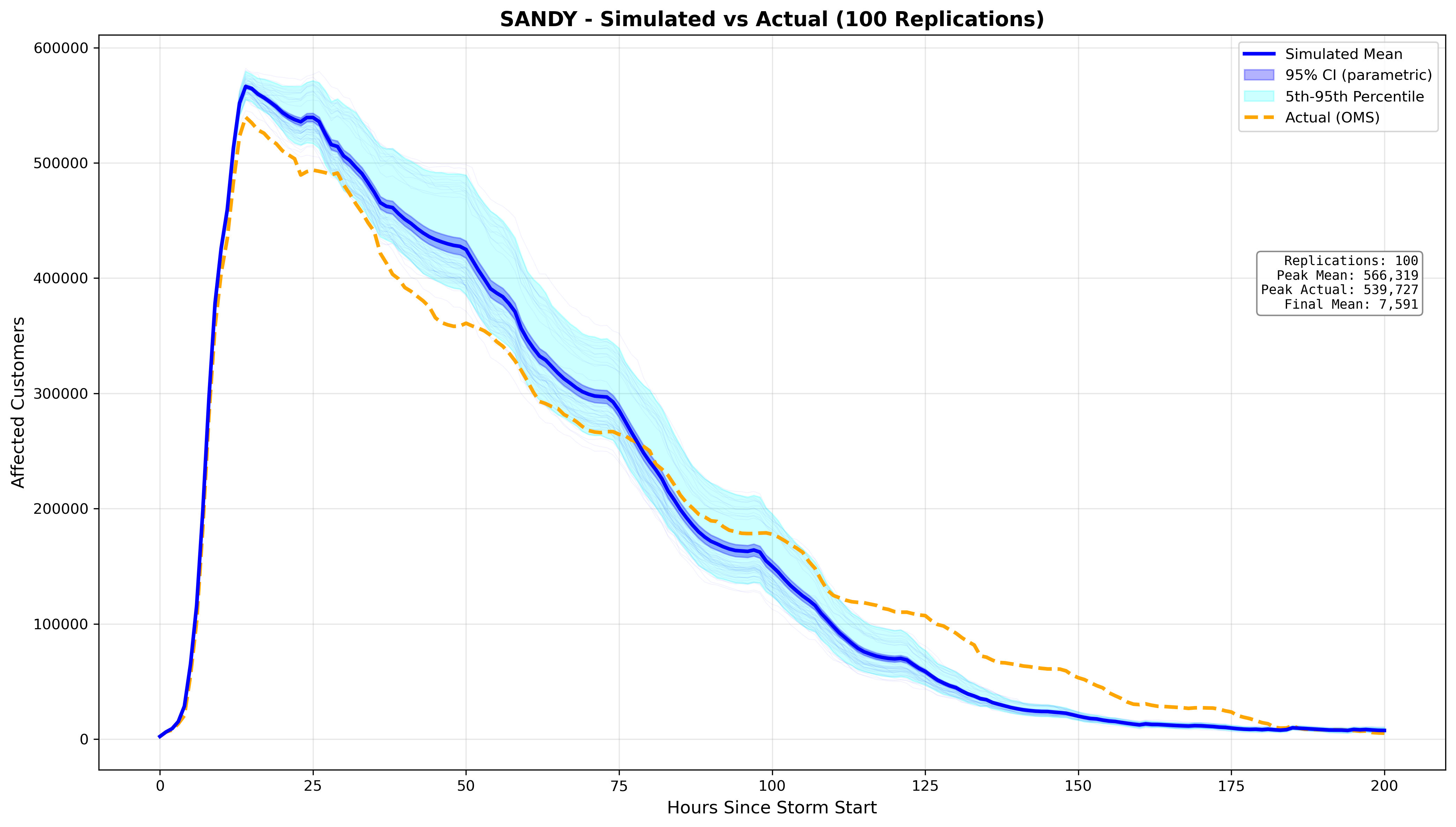
Second Place: Sloane Poppei – Near-Surface Weather Validation of Selected OPM Rain-Wind Storms. Department of Civil and Environmental Engineering
This study examined whether biases in weather forecasts may influence the performance of Eversource’s Outage Prediction Model (OPM). Weather simulations from the WRF model were compared with observations from 24 stations across Connecticut, Massachusetts, and New Hampshire for 293 rain-wind storms between 2005 and 2023.
While wind forecast bias was similar across storms, precipitation showed a clear pattern: storms where OPM overpredicted outages tended to have higher simulated precipitation than observed, while storms where outages were underpredicted tended to have lower simulated precipitation. These results suggest that precipitation forecast accuracy may play an important role in improving outage prediction models.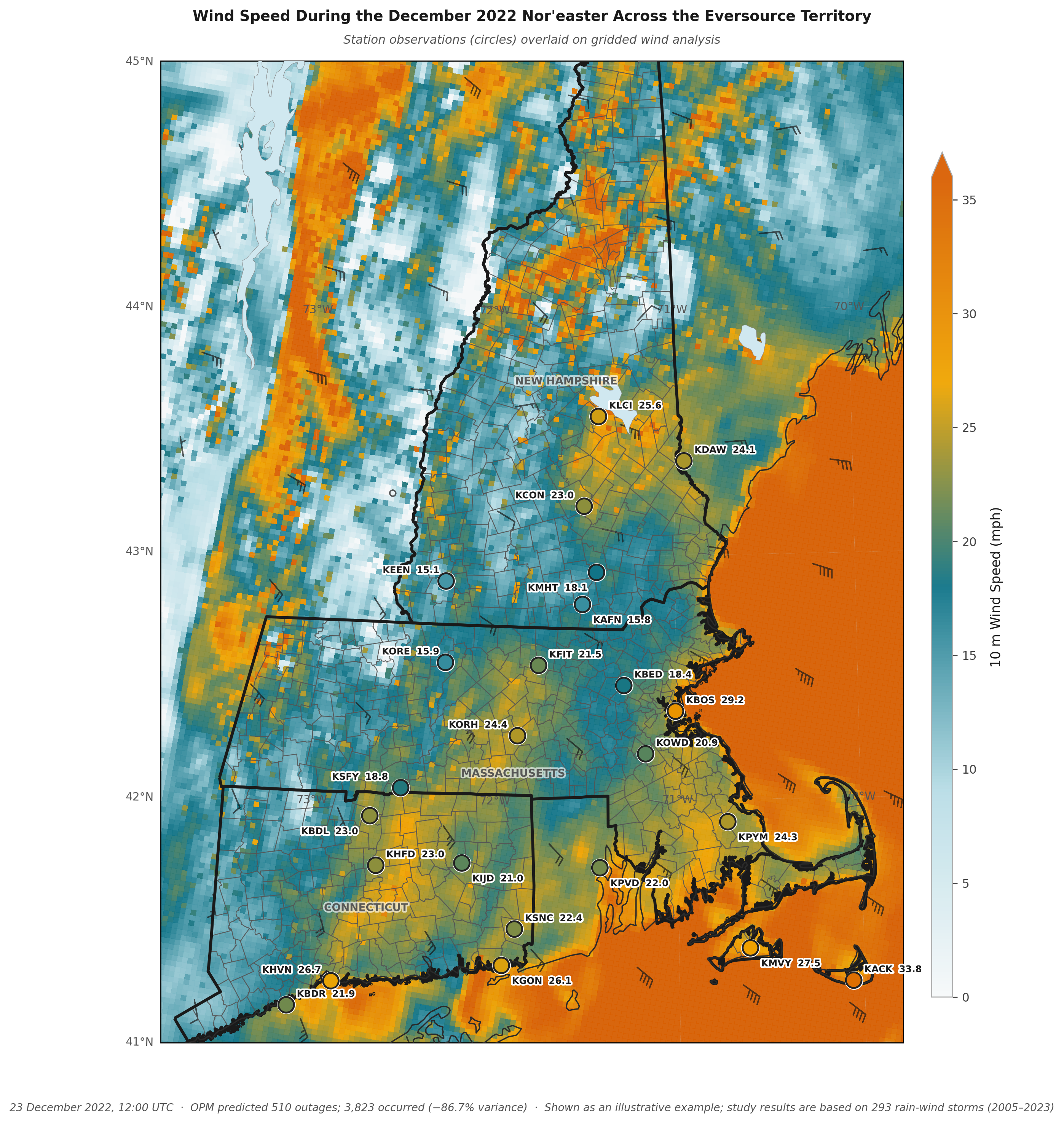
Third Place: Sidnee Everhart – Assessing Drought Effects on Edge Forest Sway Dynamics and Wind Resistance. Department of Natural Resources and the Environment
My study, Assessing Drought Effects on Edge Forest Sway Dynamics and Wind Resistance, aims to better describe how trees’ wind energy dissipating efficiency changes in response to both repeated drought events and proximity to a newly formed forest edge. The effect of climate events such as drought on tree biomechanics and stability is underrepresented in the sometimes-contradictory published literature, complicating innovation for both ecologically informed factors in tree-caused utility outage prediction and vegetation management strategy.
To address this research gap, the Applied Forest Ecology Lab (AFEL) has joined the Climate Interactions with Forest Fragmentation (CLIFF) experiment. CLIFF is a collaborative research effort led by the Reinmann Lab at the City University of New York. CLIFF is in Harvard Forest, a 4,000-acre ecological research area in Petersham, MA. CLIFF is designed to manipulate water availability in a newly formed forest edge using a rain capture and application system that simulates drought and torrential rainfall, two extreme weather conditions that are increasing across New England. CLIFF’s unifying project goal is to understand how forest removal interacts with climate in human-dominated landscapes.
This partnership has created a unique opportunity to measure not only tree sway and weather conditions, but a myriad of other interacting environmental and physiological factors in an experimentally controlled setting. By analyzing these factors in concert with tree sway and wind speed, we will gain novel insight into trees as living, dynamic mechanical systems and the strategies with which they cope with environmental stress. 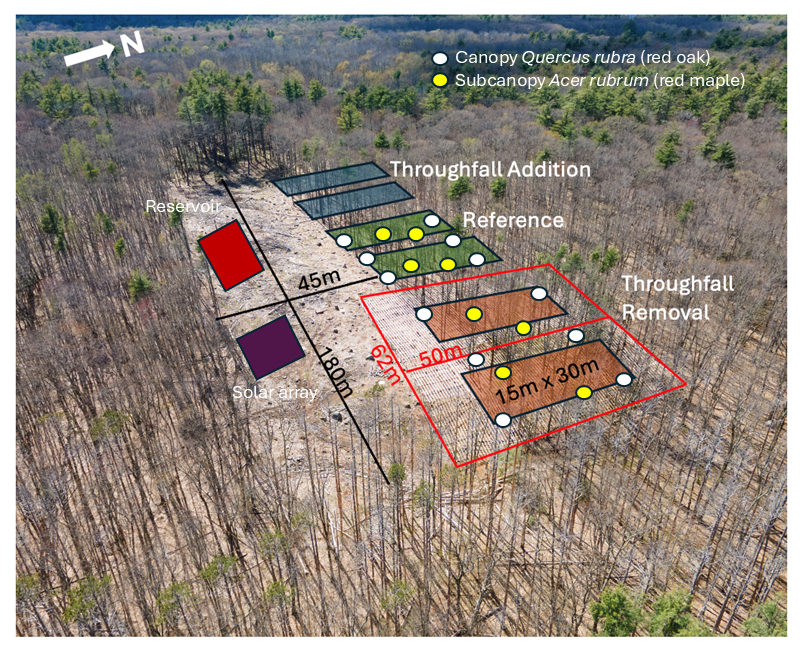
Published: March 16, 2026
Categories: Recent News, Recent News
Available Archives